Article 2 of the Constitution Describes Presidential Powers
Article II describes the organization and power of the Executive branch which includes the president. The president shall be commander in chief of the army and navy of the united states and of the militia of the several states when called into the actual service of the united states.

Article Ii The National Constitution Center
The threat of treason.

. A Article II of the Constitution states that the president is also leader of the Senate. The ability to grant pardons. What is your position on the use of presidential pardon authority.
Article II of the Constitution deals mainly with the powers and duties of the President who heads the executive branch of the US government. While Article I and Article III grant power to groups of people the legislature and the courts Article II mostly deals with one person the president. What does article 2 of the constitution of the US.
Commander of the army. Along with counsel and advice from the Senate the President is given the authority to appoint judges ambassadors and other public officials. The Constitution is a document of economy.
He is also the Commander in Chief with power over the military. The ability to make treaties. A complete list of the Presidents powers can be found in Article II Section 1 2 and 3 of the Constitution.
And he shall nominate and by and with the advice and consent of the senate shall appoint ambassadors other public ministers and consuls judges of the supreme court and all other officers of the united. He shall hold his office during the term of four years and together with the Vice President chosen for the same term be elected as follows. Section 2 also requires the principal officer of any executive department to tender advice.
The executive power shall be vested in a President of the United States of America. The article outlines the requirements to be president the election process and the duties of the office. He shall hold his Office during the Term of four Years.
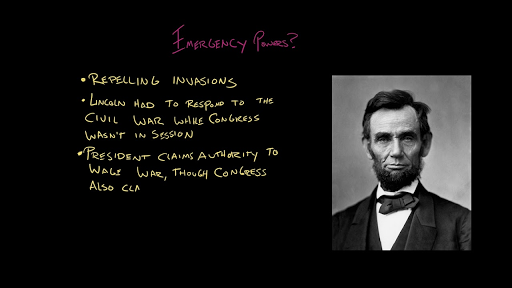
The Constitution does not expressly grant the President additional war powers or other powers in times of national emergency. The powers of the President according to the US Constitution include the power to make treaties nominate Ambassadors and nominate Supreme Court Justices. Article II The Executive Branch Article II lays out the Executive Branch of the government headed by the chief executive also known as the presidentthe branch is responsible for enforcing the laws.
The powers of the President to pass the blank if the President leaves office or cannot discharge his or her duties. Answered expert verified Article II of the Constitution describes the powers of the president and the larger executive branch. A general limitation on the power of the president is the possibility of impeachment.
This is done in about 1000 words. The President has express powers under Article II of the US Constitution. He shall have power by and with the advice and consent of the senate to make treaties provided two thirds of the senators present concur.
One of the powers granted to the president is the authority to grant pardons to individuals previously convicted of federal crimes. Notwithstanding the provisions of section 2 of Article XII laws may be passed to provide that land devoted exclusively to. Article II outlines term of office the selection the qualifications the oath the powers of appointment the responsibilities and provisions for impeachment.
Article II of the United States Constitution outlines the powers included in the executive branch. The legislative power of this State shall be vested in a General Assembly which shall consist of a. He may require the Opinion in writing of the principal Officer in each of the executive Departments upon any Subject relating to the Duties of th.
Because Article II is pretty vague presidents throughout our countrys history regardless of party have been able to push the limits of their authority leading to a slow and steady expansion of. Article II Executive Branch Pursuant to Article II Section 1 Clause 1 of the United States Constitution the executive power of the United States is vested in the President who shall serve a term of four years with the Vice President. Commander in chief of the armed forces of the United States.
The election of the President and Vice President is accomplished by majority vote of Electors. The President shall be Commander in Chief of the Army and Navy of the United States and of the Militia of the several States when called into the actual Service of the United States. Article II Section 1.
The powers of the President are set forth in Article II Section 2 and include. Constitutional Powers of the President Article. This section gives the president the power to grant pardons.
Article 2 Section 2 Clause 2 gives the President power to sign treaties on behalf of the United States in conjunction with counsel from the Senate and at least two-thirds support. The principal source of this power is Article II of the US Constitution. They are that the President is the Commander in Chief of the US Military and the power to take care that the laws of the US.
Article 2 Section 2 Clause 2 gives the President power to sign treaties on behalf of the United States in conjunction with counsel from the Senate and at least two-thirds support. The executive Power shall be vested in a President of the United States of America. Section 2 of Article Two lays out the powers of the presidency establishing that the president serves as the commander-in-chief of the military among many other roles.
And of the state forces when they are called up to national service Power to pardon. In Article II of the new Constitution the framers offered the world something entirely new. He may require the opinion in writing of the principal officer in each of the executive departments upon any subject relating to the duties of their respective.
Article Ii Of The Constitution Video Khan Academy

Article 2 Of The Constitution
Article Ii The National Constitution Center
Article 2 Of The Constitution
No comments for "Article 2 of the Constitution Describes Presidential Powers"
Post a Comment